Serial Experiments Lain: The Impact of Technology on an Online Generation
And you don't seem to understand...

Introduction
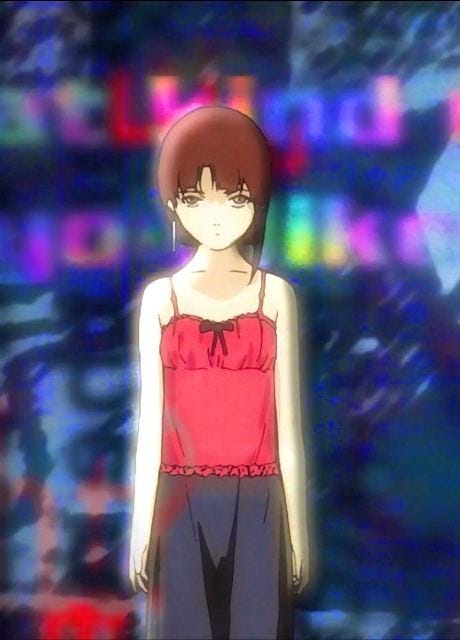
Serial Experiments Lain is a 1998 anime television series that follows a young school girl named Lain Iwakura who logs onto the Wired, a fictional internet counterpart, after the abrupt suicide of her classmate. This opens the door to a new world of hallucinations and memories. As Lain becomes more engrossed in the Wired we watch as the line between the digital world and reality begins to blur. Serial Experiments Lain uses surreal story telling to portray the ugly real-world effects that technology has on our generation.
Community and Identity
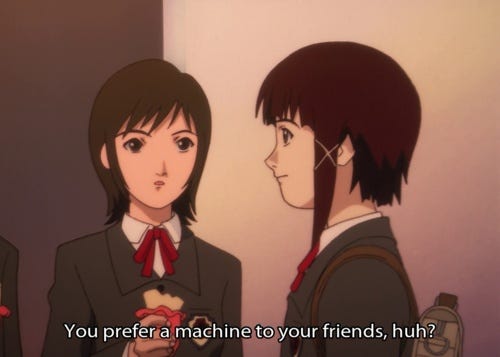
As the Wired’s presence grows in Lain’s life, it unravels an Alice in Wonderland-esque rabbit hole that becomes increasingly troublesome. Each episode is a different layer to the complex whole that is Serial Experiments Lain. In the aftermath of a classmate’s suicide, a mysterious email is spread around school, claiming to be from the deceased student. The email states that the student is not dead, she has simply given up her body and exists solely in the Wired. This is the origin of Lain’s interest in the Wired and what leads her into its labyrinth. As she continues to isolate and withdraw her classmates take note and attempt to coerce her to go out with them by saying, “Life’s depressing when you’re always alone.” Lain responds to this by saying, “Yeah, but I’m not really alone.” referring to her Navi (an advanced computer system).
Lain’s identity becomes so tied to the Wired that she begins to experience depersonalization. According to researchers at The National Library of Medicine, “Depersonalization is defined as an alteration of perception and a feeling of the self as strange or unreal, or by feeling detached from, or as an outside observer of, one's thoughts, feelings, sensations, body, or actions.” Lain shows symptoms of depersonalization which is visually portrayed to the audience by the existence of an alter ego. Lain’s alter ego is a physical manifestation of her online persona. The “Lain of the Wired” is confident, brash, and ruthless unlike Lain’s typical shy, introverted, and sensitive nature. As Lain begins to invest more of herself into the Wired, her family begins to notice and her father warns her, “It’s just an advanced medium for communication. Don’t ever get it confused with the real world.” Lain replies, “You’re wrong, the border between the two isn’t so clear.”

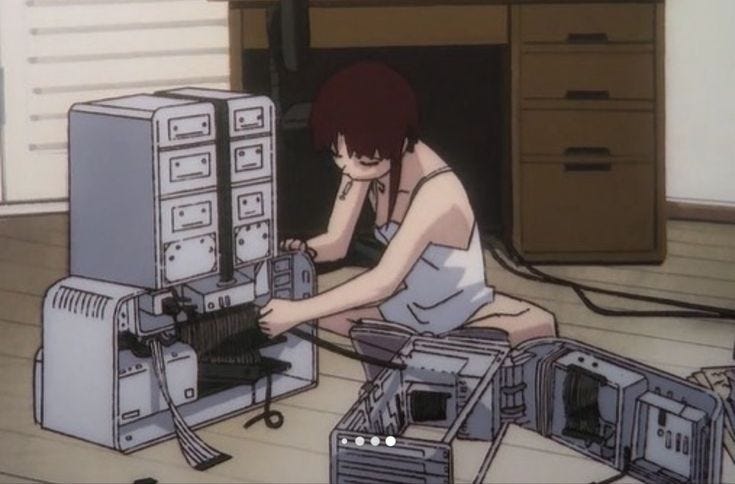
Film studies graduate Elya Myers notes that, “The more advanced modifications Lain makes to her software programming and hardware, the more she becomes part of the machinery itself.” Lain struggles interpersonally, and we find that by utilizing the Wired her community and identity both begin to warp. We must also be careful not to confuse the online world with a real community and resist the urge to retreat into a digital persona.
Desensitization
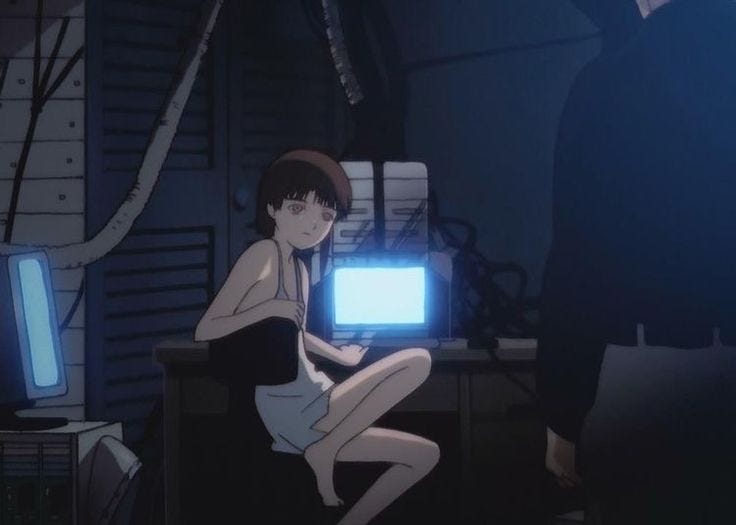
One of the most troubling side effects of the internet is desensitization. What amplifies the severity of the problem is how universal it is. Whether we are conscious of it or not, we are all being conditioned. Desensitization refers to the absence of an emotional response due to gradual exposure. We can recognize the consequences of this in how apathetic our generation has become. The internet force feeds us violence and hate until we become accustomed to it. In Serial Experiments Lain, desensitization is portrayed by Lain’s classmates. Alice, Lain’s classmate and best friend, becomes aware of this and begins to question the group after witnessing the real death of a young boy. Like most school aged children, Lain experiences peer pressure from her classmates, they convince her to come to a club called Cyberia. It is at this club that Lain and her classmates witness a shooting. Lain is driven home by the police where she finds her family has disappeared for the night. In order to cope with the horrors she has faced, she logs onto the Wired.
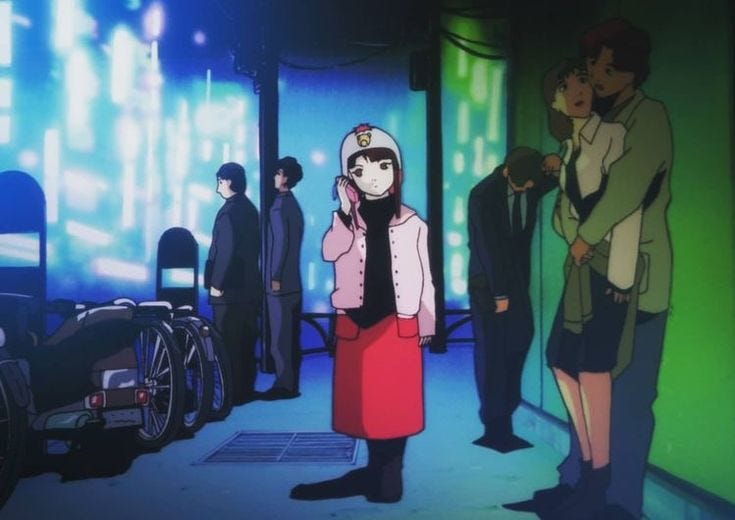
Episode three titled Layer 03: Psyche, marks a turning point in the show’s direction. Lain receives a Psyche chip in the mail, a computer chip that is meant to allow her Navi to further blur the lines between reality and the Wired. As the episode begins we see Alice crying in Lain’s lap asking for forgiveness for dragging her along to Cyberia, which resulted in her witnessing the shooting. This moment is significant because it reveals how different Alice is from her peers and how caring she is for Lain, this moment brings them closer. Later when Lain arrives at school, she overhears her classmates recounting the events. Instead of feeling trauma for what they had witnessed, they giggled and asked Alice, who was the closest to the boy, if he was cute and if she was splattered with his blood. Shortly after, Alice says “Reika, I think there’s something wrong with us. I mean last night, we saw someone actually die right in front of us. But we’re acting like it’s something we saw in some kind of a horror movie or something.” Reika responds saying she knows that she was there, but none of it felt real. What Alice and her classmates have experienced is desensitization. They have become so numb to violence that witnessing a death right in front of their eyes feels foreign, like it was from a horror movie instead.
Over-connectedness
“People’s memories aren’t just personal, they’re shared in the collective unconscious.” This line comes from the final episode of the show. It is directly referencing psychologist Carl Jung, the founder of analytic psychology. One of the most prevalent themes in Serial Experiments Lain is this idea of a collective unconscious and what manipulates it. Lain believes that she is a sentient program made to act as the bridge between the physical and virtual world. She has evolved into a god-like entity. Lain’s purpose is to unite human minds through the Wired, therefore creating a Jungian collective subconsciousness. In later episodes, the idea of memory becomes central to the show’s lore.
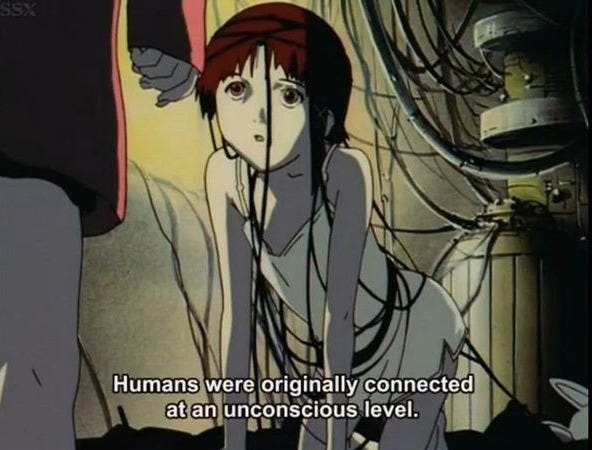
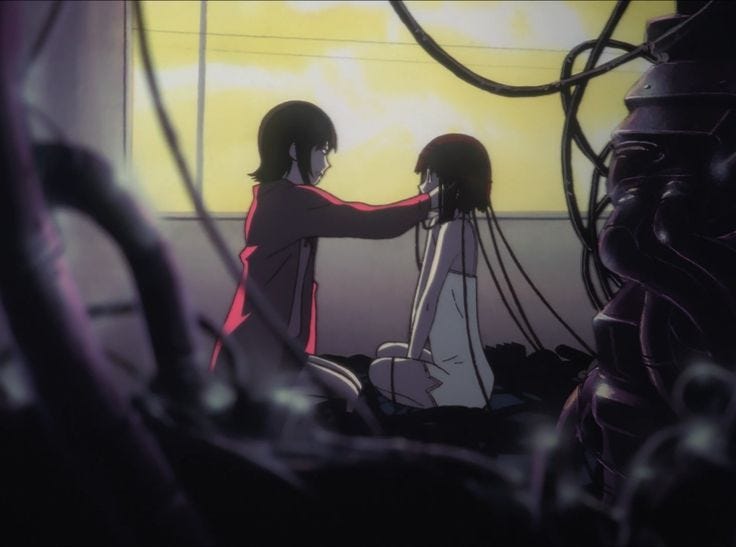
As Lain merges with technology, Alice begins to suffer. Alice remains an anchor for Lain despite the psychological horrors she is faced with. Lain becomes desperate to undo the pain that she has caused her dear friend as a result of her accidental disregard of Alice’s autonomy. In order to truly undo the damage she has done, Lain makes the decision to turn back time and erase herself entirely from everyone’s memories. In the end Lain comes to realize that the love she has felt from Alice is much greater than anything the Wired could provide. Her single bond with Alice is much more meaningful than anything she could receive from a connection with all of humanity. Social Media begs us to contribute to this suffocating over-connectedness. It urges us to keep up with everyone we’ve ever encountered. However it is only when we reject this notion that we find true connections with those who matter.
Conclusion
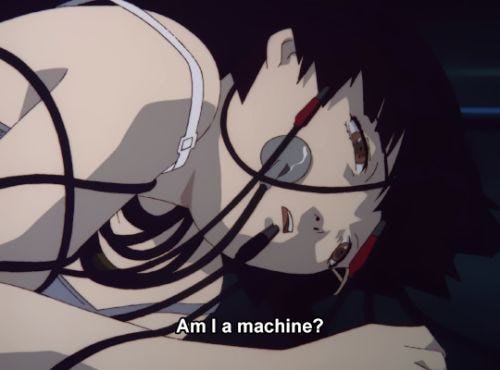
Serial Experiments Lain serves as a cautionary tale for an audience that exists in a world that is only becoming more and more online. Lain’s character acts as an allegory warning against the amalgamation of one’s self and the internet. Despite only consisting of thirteen episodes, this show is incredibly nuanced and complex. I chose to focus on what I believed to be the most relevant information regarding the negative impacts of technology and hardly managed to scrape the surface of the show’s messaging. In all, I believe Serial Experience Lain is a modern masterpiece. It expertly combines philosophy, psychology, and technology into a puzzle that is still left to be solved.
References
Myers, View All Posts by Elya. “Reconfiguring Mental Illness and Identity in Serial Experiments Lain.” Short Ends, 24 Feb. 2022, shortends.ca/2021/11/01/reconfiguring-mental-illness-identity-in-serial-experiments-lain.
Serial Experiments Lain. Directed by Yasuyuki Ueda and Ryutaro Nakamura, Triangle Staff, July 1999.
Wilkhoo, Harsahaj Singh, et al. “Depersonalization-Derealization Disorder: Etiological Mechanism, Diagnosis and Management.” Discoveries, vol. 12, no. 2, June 2024, p. e190. https://doi.org/10.15190/d.2024.09.
Great essay!! I love this show